
Give Way
The primary meaning of the Give Way is: "Yield the right-of-way to other traffic.". When you see the Give Way, it conveys a direct regulatory instruction or warning that you must follow immediately. In the hierarchy of road rules, Mandatory signs carry legal weight, meaning that disobeying them is not just unsafe, it is a traffic violation. The design of the sign, including its color scheme and shape, is standardized internationally to ensure that drivers can recognize it instantly from a distance, even under poor visibility conditions like rain, fog, or nighttime driving. In detail, this means: Instructs drivers to slow down or stop to let vehicles crossing or merging from another direction pass first.. Every motorist must familiarize themselves with this definition to ensure complete compliance.
1. Sign Overview
The Give Way is one of the most critical road safety indicators in the Mandatory signs category. Its primary purpose is to regulate traffic flow, prevent collisions, and ensure the safety of both drivers and pedestrians. Understanding this sign is essential for passing your driving license exam and for safe everyday driving.
This educational guide provides a comprehensive breakdown of the Give Way, including its meaning, legal implications, common mistakes to avoid, and real-life driving scenarios. By adhering to the directives of this sign, you contribute to a safer, more efficient road network for everyone. This sign belongs to the Mandatory category which represents rules that must be followed by law.
2. Meaning of Sign
The primary meaning of the Give Way is: "Yield the right-of-way to other traffic.".
When you see the Give Way, it conveys a direct regulatory instruction or warning that you must follow immediately. In the hierarchy of road rules, Mandatory signs carry legal weight, meaning that disobeying them is not just unsafe, it is a traffic violation. The design of the sign, including its color scheme and shape, is standardized internationally to ensure that drivers can recognize it instantly from a distance, even under poor visibility conditions like rain, fog, or nighttime driving.
In detail, this means: Instructs drivers to slow down or stop to let vehicles crossing or merging from another direction pass first.. Every motorist must familiarize themselves with this definition to ensure complete compliance.
3. Why This Sign Is Important
The Give Way is extremely important because it prevents conflicts between vehicles crossing paths and protects vulnerable road users such as pedestrians and cyclists. Failing to respect this sign is a leading cause of side-impact collisions, intersection accidents, and pedestrian injuries.
By understanding why the Give Way is placed in specific areas, drivers can develop a defensive driving mindset. The sign is strategically positioned to manage risk at points where visibility might be limited, where speed differences between merging roads are high, or where pedestrian foot traffic is dense. Disobeying this sign compromises the safety of the entire street and can lead to catastrophic accidents.
4. Where This Sign Is Used
You will typically encounter the Give Way in the following locations: 1. Busy urban intersections where traffic lights are not installed or are temporarily out of service. 2. Blind corners and sharp curves where oncoming traffic cannot be seen clearly. 3. Near schools, hospitals, and residential zones to protect pedestrians and children. 4. Merge lanes on highways, roundabouts, and expressway exits where vehicles must coordinate entry. 5. Railway crossings and toll plaza approaches to slow down vehicles for inspection. Specifically, Usually found at roundabouts, major road intersections, and merge lanes.. It is positioned so that drivers have ample reaction time to adjust their speed and position.
5. Driver Instructions
When approaching the Give Way, drivers must follow these step-by-step instructions: 1. Reduce Speed: Begin slowing down as soon as the sign becomes visible. Do not wait until you reach the sign to brake hard. 2. Observe Surroundings: Scan the road ahead, check your mirrors, and look out for pedestrians, cyclists, and other vehicles. 3. Take Action: Obey the sign's specific command (e.g., stop completely, yield, keep left, or stay within speed limits). 4. Proceed with Caution: Only proceed when it is safe to do so and the way is clear. Always yield right-of-way to vehicles already in the intersection. 5. No Sudden Maneuvers: Ensure you perform all transitions smoothly without disrupting the flow of traffic behind you.
6. Common Mistakes Drivers Make
Drivers frequently make several errors when encountering the Give Way:
7. Traffic Violations Related To This Sign
A violation occurs whenever a driver fails to comply with the explicit directive of the Give Way. This includes failing to stop, speeding past the limit, parking in prohibited areas, or overtaking where it is banned. Traffic police and automated speed/red-light cameras actively monitor zones marked by the Give Way to catch and ticket violators. Committing a violation leads to an official record on your license database, which can affect your insurance premiums and lead to stricter penalties.
8. Penalty & Fine Information
Disobeying the Give Way is a punishable offense under the Motor Vehicles Act. Violations typically result in:
9. Safety Tips
To stay safe and avoid fines, keep these tips in mind:
10. Real-Life Driving Example
Imagine you are driving home at night through a residential neighborhood. As you approach an intersection, you spot the Give Way ahead. Instead of rushing through, you slow down, bring your vehicle to a safe stop, and scan the crosswalks. Suddenly, a cyclist wearing dark clothing crosses from the left. Because you obeyed the Give Way and stopped, you are able to let the cyclist pass safely, avoiding a potentially fatal accident. This illustrates how compliance directly saves lives.
 Stop Sign
 No Entry
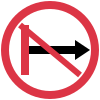 One Way Right
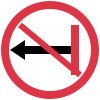 One Way Left