Two-Wheeler Driving Test Guide (RTO Track)
Introduction
To obtain a permanent two-wheeler driving licence (motorcycle with or without gear), applicants must pass a practical driving test at the Regional Transport Office (RTO). The test evaluates your balance, throttle control, signaling, and knowledge of traffic rules.
RTO test tracks are designed with specific layouts, including figure-8 paths and slalom cones. Knowing the track layout and practicing key maneuvers is essential to pass the test on your first attempt.
Eligibility Criteria
To take the two-wheeler practical driving test, you must: 1. Valid LL: Hold a valid Learner's Licence for two-wheelers. 2. Age Criteria: Minimum 16 years for gearless vehicles up to 50cc; minimum 18 years for geared motorcycles. 3. Practice Period: Complete the mandatory 30-day practice period after receiving your Learner's Licence.
Required Documents
Bring these documents to the RTO on your test day:
Fees & Charges
The fees for the two-wheeler driving test on the Sarathi Parivahan portal are:
| Fee Item | Amount (in Rs.) | Notes |
|---|---|---|
| Two-Wheeler Test Fee | Rs. 300 | Applied per test attempt. |
| DL Issuance Fee | Rs. 200 | Smart card printing charge. |
| Total Fee | Rs. 500 | Paid online during slot booking. |
If you fail the test, you must pay the Rs. 300 test fee again to book a new slot.
Step-by-Step Process
Follow these steps to pass your two-wheeler driving test: 1. Pre-test Prep: Wear an ISI-marked helmet with the chin strap fastened. 2. Inspect the Track: Walk the track to understand the layout, including the figure-8, slalom cones, and stop lines. 3. Maneuver the Figure-8: Drive through the figure-8 track clockwise and counterclockwise. Do not touch the boundary lines or put your feet down. 4. Pass the Slalom Test: Steer between traffic cones placed in a straight line, showing throttle-clutch coordination at low speed. 5. Sudden Stop & Restart: Accelerate to 20 km/h, stop smoothly at the stop line without locking the brakes, and restart on a slight incline without rolling back. 6. Hand and Indicator Signals: Show clear hand signals for turning left, right, and stopping, alongside using the electric indicators.
Maneuver the "Figure 8" Track
Drive the motorcycle through a designated figure-8 track pattern without touching the boundary lines or putting your feet down on the ground.
Demonstrate Hand & Indicator Signals
Show clear hand signals for turning right, turning left, and slowing down, along with turning on the electrical indicators.
Pass the Slalom / Serpent Test
Steer between traffic cones placed in a straight line, demonstrating agility and clutch-throttle coordination at low speed.
Execute Sudden Stop & Restart
Bring the two-wheeler to a halt smoothly upon command without locking the brakes, and restart on a slight gradient without rolling back.
Timeline
Estimated timeline for the test day and results:
Common Mistakes
Common mistakes that cause applicants to fail the two-wheeler test:
Important Notes
Key safety rules for the two-wheeler test:
Conclusion
Passing the RTO two-wheeler test requires balance, control, and practice. By mastering the figure-8, using hand signals, and wearing proper safety gear, you can pass the test and ride safely on public roads.
Frequently Asked Questions
Submit your applications, book test slots, pay fees, and track your application status on official government transport portals.
 Stop Sign
 Give Way
 No Entry
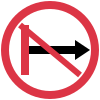 One Way Right