Understanding Road Lane Markings
Introduction
Road safety and regulatory compliance are the cornerstones of civilized driving. This article on "Understanding Road Lane Markings" covers the essential rules, guidelines, and legal provisions that every motorist must follow. By adhering to these regulations, you ensure a safe and smooth journey for yourself and other road users.
Understanding these rules is not just a requirement for passing your driving tests; it is a critical skill for defensive driving. Roads are shared spaces, and predictability is the key to collision prevention. This detailed guide breaks down the core concepts, legal fines, common violations, and safety tips. Every driver should recognize that traffic laws are not arbitrary constraints. They are carefully designed guidelines meant to protect human lives. By failing to comply with the basics of "Understanding Road Lane Markings", a driver risks not only a traffic ticket, but also causing major accidents, bodily harm, and traffic bottlenecks. In this educational post, we deep dive into the legal frameworks, standard procedures, and best practices for safe compliance on public roads.
Rule Explanation
The concept of "Understanding Road Lane Markings" is designed to organize traffic flow, minimize gridlocks, and prevent collisions. Understanding the logic behind these rules helps drivers appreciate their value rather than seeing them as mere restrictions. Each category of road rules is backed by civil engineering standards and behavioral research, ensuring that traffic moves in a predictable and safe manner.
For instance, guidelines under General Rules are formulated based on reaction times, braking distances, and vehicle mechanics. When speed limits or signal sequences are set, engineers analyze visibility, pedestrian volumes, and historical accident data to find the optimal safety parameters. Furthermore, complying with these guidelines reduces the wear and tear on your vehicle. Sudden braking, erratic overtaking maneuvers, and ignoring traffic warnings place excessive load on your engine, transmission, and brakes. By driving with a steady speed and complying with standard practices, you also improve fuel efficiency and lower carbon emissions. Safe driving is therefore a win-win for both safety and resource preservation.
Practical Examples
Here are some common real-life examples illustrating how these rules apply on the road:
Penalties & Fines
Violations of "Understanding Road Lane Markings" carry significant legal and financial consequences under the Motor Vehicles Act:
Common Violations
Common violations that traffic police routinely catch drivers committing include:
Safety & Compliance Tips
To ensure you stay compliant and safe, follow these expert driving tips:
 Stop Sign
 Give Way
 No Entry
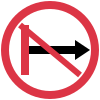 One Way Right