No Parking Zones & Towing Recovery Guidelines
Introduction
To maintain smooth traffic flow in congested cities, municipal and traffic police authorities designate specific streets as "No Parking Zones". Parking in these zones causes bottlenecks, blocks emergency vehicles, and results in your vehicle being towed. Understanding where parking is restricted and how to recover a towed vehicle is essential for urban drivers. For local municipal regulations, visit the [MoRTH India Portal](https://morth.nic.in).
Rule Explanation
No parking zones are marked by regulatory signs (a blue circle with a red border and a single diagonal red line) or solid yellow paint on the curb. Some areas are designated as "No Stopping or Standing" zones, where vehicles cannot stop even for a second. Here are the restricted parking zones and the risks of towing:
| Zone Location | Parking Restriction | Towing Risk |
|---|---|---|
| Near Intersection (within 10m) | Prohibited by law; blocks turning sightlines. | High Towing Risk |
| Bus Stops & Fire Hydrants | Restricted; blocks public services. | Immediate Towing |
| Solid Yellow Curb Lines | No Parking zone. | High Towing Risk |
| Flyovers, Tunnels & Bridges | Dangerous obstruction; strictly banned. | Immediate Towing |
| In front of Private Gateways | Blocks residential access. | Towed if reported by owner |
If your vehicle is towed, you must pay both the traffic violation fine and the private towing operator's charges.
Practical Examples
Real-world towing recovery scenarios: 1. Towed Vehicle Recovery: If you return to your parked car and find it gone, check with nearby shops or call the traffic police helpline. You must visit the designated traffic police yard, pay the fine, show your RC and driving license, and pay towing charges to release the vehicle. 2. Double Parking: Leaving your car parallel to a vehicle already parked at the curb blocks an entire lane; this results in immediate towing. 3. Emergency Breakdown: If your car breaks down in a no-parking zone, raise the hood, turn on hazard lights, and arrange a private tow truck immediately to avoid police towing.
Penalties & Fines
Parking in restricted zones carries strict penalties:
Common Violations
Typical parking violations in urban areas:
Safety & Compliance Tips
Tips to avoid towing:
Frequently Asked Questions
This content is aligned with the Motor Vehicles Act, 1988 and Central Motor Vehicles Rules. Always verify with official notifications for the latest amendments.
 Stop Sign
 Give Way
 No Entry
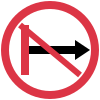 One Way Right