Parallel Parking Rules & Safety Checklist
Introduction
Parallel parking—parking a vehicle parallel to the curb, in line with other parked cars—is one of the most challenging maneuvers for new drivers. It is a mandatory skill tested during the RTO driving license exam. Proper parallel parking ensures your vehicle does not block active traffic lanes or obstruct other parked cars. For official parking guidelines, refer to the [Parivahan Portal](https://parivahan.gov.in).
Rule Explanation
Parallel parking requires precise steering, mirror coordination, and speed control. Drivers must select a parking space that is at least 1.5 times the length of their vehicle to park safely without hitting other cars. Here is the step-by-step parallel parking guide and checklist:
| Step Number | Maneuver | Action Required |
|---|---|---|
| 1 | Align Vehicles | Pull up alongside the car parked in front of the empty space, leaving a 1-meter gap. |
| 2 | Reverse & Angle | Shift to reverse, turn steering wheel fully right, and reverse slowly until your car is at a 45-degree angle. |
| 3 | Straighten & Enter | Straighten the steering wheel and reverse until your front bumper clears the rear bumper of the front car. |
| 4 | Turn Left & Tuck | Turn steering wheel fully left and reverse to tuck the front of your car into the space. |
| 5 | Center & Align | Shift to first gear, straighten wheels, and center the car between the front and rear vehicles. |
Your tires must be parked within 30 cm of the curb to prevent blocking the road.
Practical Examples
Real-world parking scenarios: 1. RTO Driving Test: During the practical test, you must parallel park your car within a designated box marked by cones in under 3 minutes without touching any cones. 2. Parking on Incline: If parallel parking on a downhill slope, turn your wheels toward the curb. If parking uphill, turn your wheels away from the curb to prevent rolling. 3. Hazard Signaling: Turn on your hazard warning lights before starting the parallel parking maneuver to alert vehicles behind you to slow down.
Penalties & Fines
Improper parking carries significant penalties:
Common Violations
Typical parallel parking mistakes:
Safety & Compliance Tips
Safety tips for parallel parking:
Frequently Asked Questions
This content is aligned with the Motor Vehicles Act, 1988 and Central Motor Vehicles Rules. Always verify with official notifications for the latest amendments.
 Stop Sign
 Give Way
 No Entry
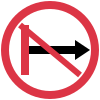 One Way Right